Begin before the robot moves
A rigid component usually keeps its geometry when lifted. A sheet can drape, stretch, fold over itself or pull another item from a pile. Towels add texture and thickness; duvet covers can trap smaller pieces inside. Moisture changes mass and friction. These characteristics make textile presentation a central part of the system, rather than a minor feeding detail.
Singulation means separating a load into individual items suitable for the next task. It may involve controlled feeding, lifting, spreading or re-presenting a pile. The objective is not always a perfectly flat textile. It is a presentation that gives the next operation enough certainty: an accessible edge, a visible corner or a single isolated item. Define that condition before choosing a robot.
Match the contact to the material
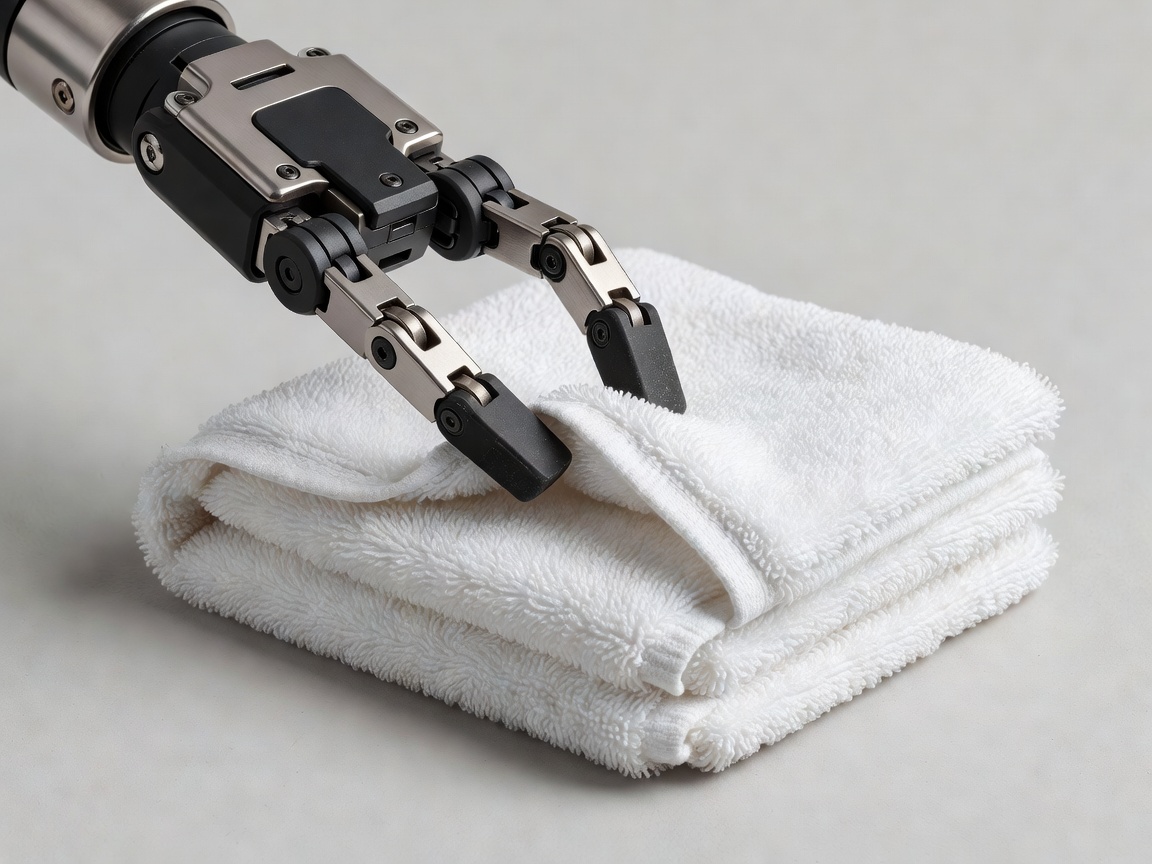
Mechanical pinch grippers can hold an edge or fold, but contact pressure and jaw shape matter. Suction can assist with some presentations, yet porous fabric allows air leakage and folded surfaces can behave unpredictably. Other end effectors use specialised engagement methods. No mechanism should be assumed suitable for every hotel textile or every stage of processing.
Evaluate the interaction with seams, decorative borders, worn areas and damp fabric. Ask whether the contact can mark, snag or stretch the item. Consider cleaning access and the risk of carrying contamination between tasks. A technically successful lift is not enough if the gripper damages stock or cannot be incorporated into the laundry’s cleaning regime. Maintenance instructions and supplier limits belong in the operating plan.
Check the outcome, not just the command
A robot controller reporting that a movement finished does not prove that one towel arrived correctly. The item may have slipped, remained entangled or dragged a second textile along. Depending on the application, vision, force sensing, presence detection or weight changes can support verification. The system needs an explicit interpretation of these signals, including a response when they disagree.
Verification should cover both ends of the transfer. Confirm that the source no longer contains the intended item where appropriate, and that the destination received it in a usable orientation. A finishing feeder may require corners or edges in particular positions. A cart may only require a controlled deposit. These are different success criteria and should not be combined into one vague handling claim.
Make human intervention part of the design
A recovery procedure should explain how the equipment reaches a safe state, who may enter the area and what must be checked before restarting. An emergency stop is not a substitute for the isolation procedure required for the task. Removing a caught sheet may expose an operator to stored energy or movement in connected equipment, even when the robot itself appears still.
Risk assessment must consider the complete cell: robot, end effector, conveyors, lifts, access points and the textile itself. ISO 12100 provides a machinery risk-assessment framework. ISO 10218 addresses industrial robot safety, while ISO 13849-1 concerns safety-related parts of control systems. The applicable editions, machinery configuration and local legal obligations require competent assessment; naming a standard does not establish conformity.
Trial the awkward cases on purpose
Build the trial set from actual stock categories and their condition range. Include large sheets, small washcloths, aged towels, mixed piles and representative moisture conditions where the intended application allows them. Record the presentation method as well as the robot’s action. Otherwise, a demonstration using carefully arranged linen can create expectations that receiving staff cannot reproduce during normal work.
Assess successful transfers, repeat attempts, damage, manual interventions and recovery time together. Define how rejected cases count before the trial begins. Compare operation over a representative period rather than selecting only uninterrupted sequences. Ask how settings are controlled when the textile mix changes, and whether an operator can recognise when the system is outside its tested conditions.
The best boundary is clear: this equipment performs a defined handling task on a defined range of linen, with a verified result and a safe alternative route. That is more useful than a promise to handle anything. Once the physical transfer is dependable, workflow coordination must ensure the receiving stage is ready and the batch information travels with the textile.
Continue to workflow coordination →Where to verify safety references
Use ISO and your national standards body to confirm current standard editions and scope. In Ireland, the Health and Safety Authority provides workplace machinery guidance. A supplier demonstration is not a substitute for site-specific risk assessment and training.